Quantum x Music: Why this combination? The birth story
The story behind the birth of "Quantum x Music," which was serialized by Program Committee Chair Koji Hashimoto in the Crowdfunding Activity Report, has been summarized and republished.
Table of Contents
Quantum x Music: Why this combination? The birth story (1)
Hello, Quantum Fest. Thank you all so much for your support! We’ve already received support from over 100 people, and we’re truly grateful. So... in this activity report, I’d like to share a bit of the backstory behind the creation of “Quantum x Music.”
First, please enjoy a few of the "Quantum x Music" pieces.
Symphony (premiere in 2022) video → https://player.vimeo.com/video/912309551
When you hear that Quantum Fest, you might be wondering, “Why music?”
In fact, it has been decided that N’SO Kyoto’s “quantum compositions” will also be performed at Quantum Fest ( Münster ), Quantum FestQuantum Fest —the birthplace of quantum mechanics.German Quantum Fest → https://quantum100.de/
My collaborative research with the French composer Yannick Paget dates back to 2018, when I took to the stage and Paget was in charge of the music for the physical performance stage work "Every day is a new beginning" (written, directed, and performed by Eiichi Maeda).
Video (stage performance "Every day is a new beginning") → https://vimeo.com/280716592
At that time we were experimenting with the connection between physics and art through the body. Through the process of creating that work, we noticed a similarity between the quantum (elementary particles), which are the fundamental constituent objects of physics, and the chords, which are the fundamental constituent parts of music. If we pursued this similarity, we would discover the similarity between this fundamental principle of the universe and the principle of musical composition, and beyond that, we would be able to express the truth of the universe through music, a mind-bending object - that is where our adventure began! (continued)
Quantum x Music: Why this combination? The birth story (2)
Thank you all for your support Quantum Fest. Here’s the next installment of the story behind the creation of “Quantum x Music”!
Quantum Fest was Quantum Fest Paget.
https://www.yannickpaget.com/about/
Let us introduce you to Mr. Pagé. Mr. Pagé graduated from the Conservatoire National Supérieur de Musique de Paris with a degree in conducting and percussion. He studied with Marek Janowski, Yutaka Sado, Jorma Panula, Zsolt Nagy, and David Robertson, as well as conducting at the Royal College of Music in England. He made his debut as a percussionist with the Orchestre Philharmonique de Radio France, the Orchestre National de la Capitole de Toulouse, the Gustav Mahler Orchestra, and many others, while his debut as a conductor was in Paris, where he performed symphonic works, opera, and contemporary music, He made his conducting debut in Paris with the Orchestre National de la Capitole de Lameloup for five years. He served as assistant to Yutaka Sado at the Orchestre Lamoureux for five years, then came to Japan to serve as principal conductor of the Osaka Kyoiku University Chorus and Orchestra since 2008, and joined the Kansai City Philharmonic Orchestra as a guest conductor in 2010. He has been a guest conductor of the Kansai City Philharmonic Orchestra since 2010, giving numerous concerts in Osaka and other cities in the Kansai region every year. He has been active as a conductor throughout Japan and Europe, and has recently been conducting and composing for the theater as well.
As a professional in composition theory, conducting, and performance, Pagé was interested in the idea of the quantum governing the universe in the performing arts, which I also participated in. Music is actually composed as a sum of chords, and there is a theory behind it. The universe is also composed as a totality of quanta, and behind it is the Standard Model of elementary particles. When Mr. Paget learned how the elementary particles are unified as a theory, he decided to construct a musical universe based on the harmony and on the music theory by his own hands in a symphony of motifs based on the theory of elementary particles.
So we began to collaborate. It became a highly experimental process of trying to translate subatomic particles into chords, and then translating the interactions of the subatomic particles into a series of chords. This was the beginning of a collaborative effort to make music out of quanta. (continued)
Quantum x Music: Why this combination? The birth story (3)
I told you a little about my meeting with Yannick Paget and the beginning of our "quantum x music" collaboration in the previous [Birth Story (2)], but let me describe the subsequent developments here.
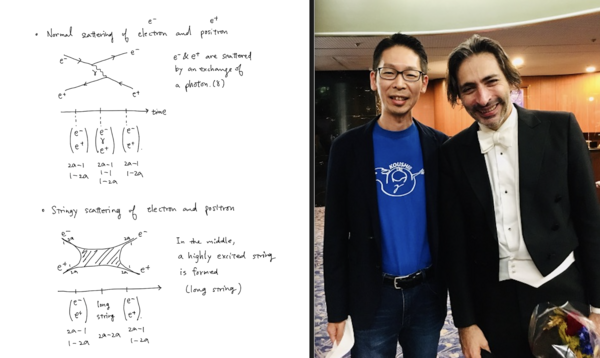
Based on the correspondence between chords and elementary particles, work has begun on translating the reactions of elementary particles into music. The mathematical formula that describes the interactions between all currently known elementary particles, called the "Standard Model of Elementary Particles," is written in terms of a principle called symmetry. According to symmetry, the 17 subatomic particles have various quantum properties that can be summed up in a combination of numbers, such as an electron has a charge of -1. The subatomic particles react in combinations where the numbers just add up to zero.
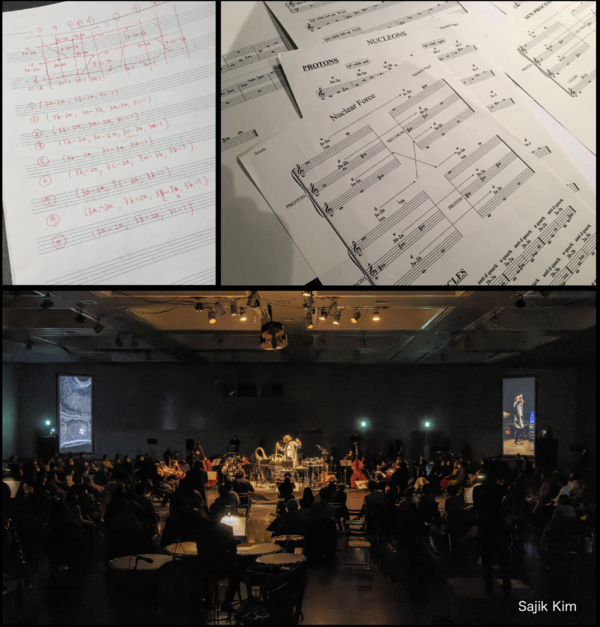
The challenge began to write down the reactions of various elementary particles, based on the Standard Model of elementary particles and string theory, and translate them into music using the rules of correspondence with chords. Physics describes typical situations in which electromagnetic interactions, weak interactions, strong forces, and gravity, each playing an active role. If we draw the reactions of elementary particles using a drawing method specific to particle theory called the "Feynman diagram," it is just like watching how elementary particles stick together or move apart, following their changes over time. If we translate this into music, we can create a flow of chords.
Of course, this will not result in music that humans will find beautiful. The music we humans enjoy is something that has evolved and developed based on the history of music up to now. Yannick Paget used his own musical theory, which he has studied and practiced, to compose music using chord sequences as motifs, based on how he noticed the reactions of elementary particles.
This process took a very long time, even for musician Yannick Paget, who will conduct the premiere of the original symphony piece, "Amaterasu," at The Symphony Hall in Osaka in September 2021 under his own direction. The work incorporated ideas such as light and gravity, and the pamphlet distributed at the theater included a lengthy explanation of physics, exposing the assembled audience to the ideas of physics.
These elements served as the foundation and ultimately came together to form a symphony. This is how Quantum Fest came into being.
Of course, music and physics are different. The symphony itself isn’t entirely based on quantum concepts. However, it was composed with the intention of exploring what humans perceive as beautiful, and to serve as a gateway to the concept of quantum physics. Yannick Paget and I collaborated on this project with mutual respect, and it has evolved into a work of art. We hope you’ll enjoy this new form of art Quantum Fest!